
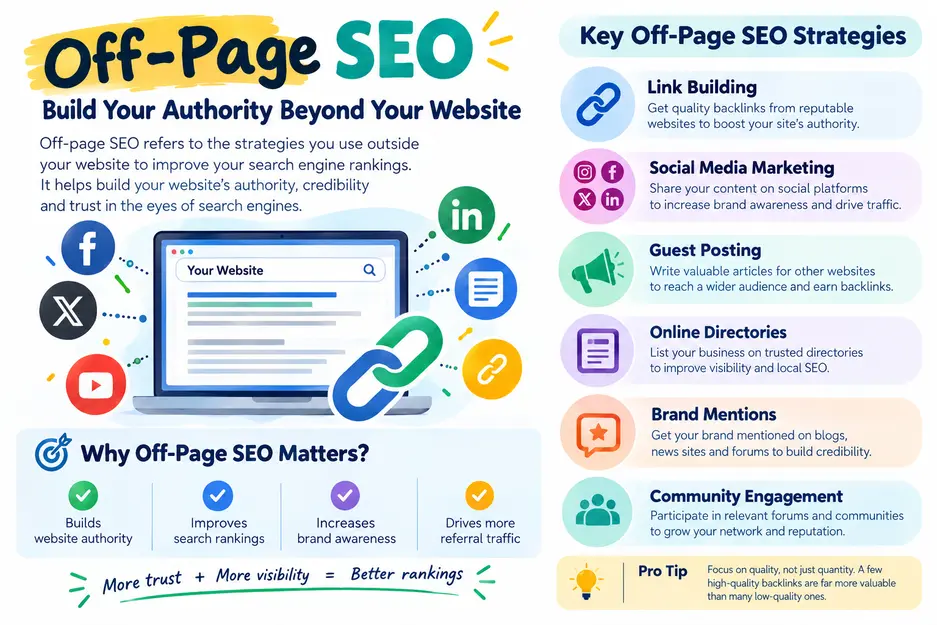
After you’ve optimized your website content via On-Page SEO, the next important step towards increasing your Google rankings would be Off-Page SEO. In On-Page SEO, you build the foundation of your website, whereas, in Off-Page SEO, you establish the authority and reputation of your website.
In this article, we will talk about what Off-Page SEO means, how backlinks play a key role in it, and some best practices of getting quality authority through it.
What is Off-Page SEO?
Off-Page SEO (or off-site SEO) is everything done on other sites that influences your Google rankings.
Consider On-Page SEO to be what you say about your own website, whereas Off-Page SEO is what others say about you.
Why are Backlinks Important?
Backlinks (or inbound links) are links to your website from external sources. For Google, backlinks serve as a vote of confidence.
Having your site linked by an authoritative site means that your website’s content is valuable and relevant.
Key Features of Quality Backlinks:
Domain Authority: Higher domain authority means higher value (or link juice).
Relevancy: Backlinks from sites from your industry mean much more than those from unrelated sites.
Anchor Text: Clickable anchor text containing a backlink should contain relevant keywords
Link Placement: Links that are naturally placed in the main content body work more effectively than those in the footer or sidebar.
Follow v/s Nofollow: Regular Dofollow links pass value, whereas Nofollow links tell search engines not to pass any value (they still generate referral traffic).
Link Placement: Links that are naturally placed in the main content body work more effectively than those in the footer or sidebar.
Follow v/s Nofollow: Regular Dofollow links pass value, whereas Nofollow links tell search engines not to pass any value (they still generate referral traffic).
Top Off-Page SEO Strategies
1. Link Building Strategies
Guest Blogging:
Produce quality articles for respectable sites related to your niche, and in return, you get a contextual backlink.
Broken Link Building:
Look for broken outbound links on websites that relate to your niche, and contact the webmaster about the link being broken, and offer your content as an alternative.
The Skyscraper Method:
Look for popular articles within your niche, produce a much better version of the article than the one posted originally, then contact those who linked to the original post.
1.Unlinked Brand Mentions:
Look for any mentions of your brand or business online which lack a link and kindly request the writer to include a link in the content.
2. Social Media Promotion
While social media posts cannot be considered ranking factors, actively promoting your content brings traffic and increases its visibility, making it more likely for you to get backlinks.
3. Local SEO and Citations
Optimize your Google My Business page.
Submit your company’s Name, Address, and Phone number details to respected online directories for local businesses.
4. Digital PR and Content Marketing
Produce original research, infographics or data analysis that bloggers, news sites and industry journalists would like to use as
Off-Page SEO Best Practices: What to Avoid
- Do Not Purchase Backlinks:
It is against Google Webmaster Guidelines to purchase links or engage in any backlinking scheme.
- Steer Clear of Directory Submission Sites:
These are just link farms; avoid them all costs.
- Use a Diverse Mix of Anchor Texts:
Your anchor texts should have a balanced mixture of keyword, naked URL, and branded phrases