
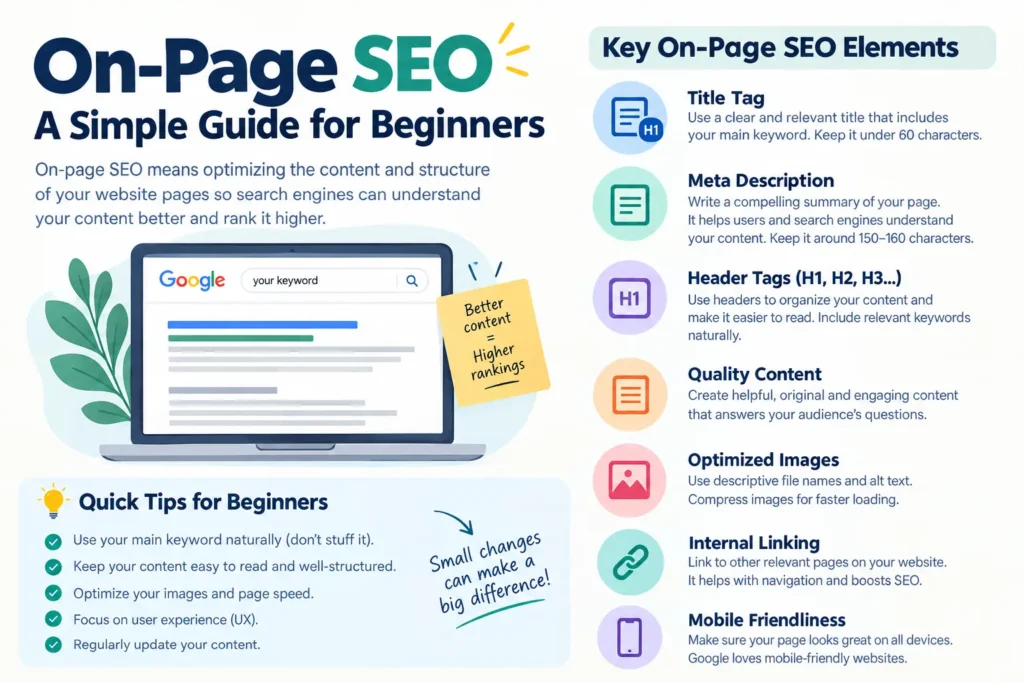
For a higher ranking and better traffic of your website on Google, On-Page SEO Guide for Beginners is the first and foremost thing you need to know. As Off-Page SEO deals with backlinks, On-Page SEO refers to the optimization of the website itself.
In this On-Page SEO guide for Beginners, you will come to know how to optimize your website with its right techniques.
What is On-Page SEO?
On-Page SEO (sometimes referred to as On-Site SEO) is the process of optimizing websites’ individual pages for better ranking and increased traffic through search engines. This process includes optimization of visible content as well as underlying HTML code of a website’s page.
Main Components of On-Page SEO Guide for Beginners That Should Be Optimized
1. Title Tags & Meta Descriptions
Title Tag: Keep it under 60 characters and put your keyword in there early. Make sure it’s catchy to boost Click-Through Rate (CTR).
Meta Description: Keep it at about 150-160 characters. It should be accurate and have a call-to-action (CTA
2. Headings & Content Structure (H1, H2, H3)
Do not use more than one H1 tag on a page (typically, the heading of your post).
Use headings in order to split up the content and make it readable for both users and spiders.
Secondary keywords should be integrated into your headings naturally.
3. URL Structure
Make sure that the URL is short and clear.
Ensure that the target keyword is included in the URL (e.g., [yourwebsite.com/on-page-seo-guide](https://yourwebsite.com/on-page-seo-guide)).
Do not use special characters or dates or anyMake sure that the URL is short and clear.
Ensure that the target keyword is included in the URL (e.g., [yourwebsite.com/on-page-seo-guide]
4. Keyword Optimization & Intent
Insert the focus keyword into the first 100 words of your writing.
Use natural keyword density (between 1% and 2%). No stuffing allowed.
Make sure that your content matches the search intent.
5. High-Quality Content & Engagement
Write unique and well-optimized content that helps solve the problem of the user.
Use bullet points, bold fonts, and short paragraphs to improve readability and increase time spent on the page.
6. Image Optimization
Give a meaningful name to your images (e.g., on-page-seo-checklist.png rather than IMG001.png).
Give all images an Alt Text to help search engines know more about the images.
Optimize images to decrease their load time.
7. Internal and External Links
Internal Links: Add 2–4 internal links pointing to related topics on your website (such as our ultimate [SEO for Beginners Guide]).
External Links: Link out to authoritative, trusted sources to support your claims and add value for readers.
Final Thoughts on On-Page SEO
On-page SEO Guide for beginners is an essential part of building a successful website and improving its visibility in search engine results. By optimizing title tags, meta descriptions, headings, URLs, images, and internal links, you can help search engines understand your content more effectively while providing a better experience for visitors.
However, successful on-page SEO Guide For Beginners is not just about adding keywords to a webpage. It also involves creating helpful, relevant, and easy-to-read content that matches the search intent of your target audience. A well-structured page allows readers to find the information they need quickly and encourages them to explore other relevant pages on your website.
Regularly reviewing your website is equally important. Check for outdated information, broken links, missing image alt text, and opportunities to improve internal linking. You can use tools such as Google Search Console and Google Analytics to understand how your pages perform and identify areas that need improvement.
Remember that SEO takes time, and no single optimization guarantees higher rankings. Focus on making meaningful improvements, following best practices, and delivering value to your audience. With consistent effort and regular monitoring, on-page SEO can help establish a stronger foundation for long-term organic traffic and website growth.