
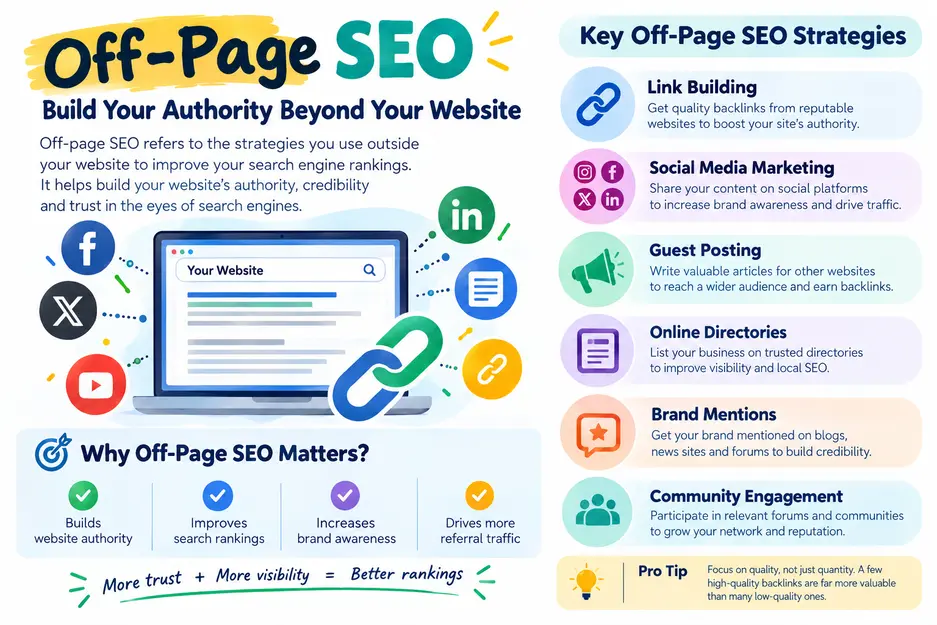
After you’ve optimized your website content via On-Page SEO, the next important step towards increasing your Google rankings would be Ultimate Guide to Off-Page SEO and Backlinks. In On-Page SEO, you build the foundation of your website, whereas, in Off-Page SEO, you establish the authority and reputation of your website.
In this article, we will talk about what Off-Page SEO means, how backlinks play a key role in it, and some best practices of getting quality authority through it.
What is Ultimate Guide to Off-Page SEO and Backlinks?
Ultimate Guide to Off-Page SEO and Backlinks (or off-site SEO) is everything done on other sites that influences your Google rankings.
Consider On-Page SEO to be what you say about your own website, whereas Off-Page SEO is what others say about you.
Why are Backlinks Important?
Backlinks (or inbound links) are links to your website from external sources. For Google, backlinks serve as a vote of confidence.
Having your site linked by an authoritative site means that your website’s content is valuable and relevant.
Key Features of Quality Backlinks:
Domain Authority: Higher domain authority means higher value (or link juice).
Relevancy: Backlinks from sites from your industry mean much more than those from unrelated sites.
Anchor Text: Clickable anchor text containing a backlink should contain relevant keywords
Link Placement: Links that are naturally placed in the main content body work more effectively than those in the footer or sidebar.
Follow v/s Nofollow: Regular Dofollow links pass value, whereas Nofollow links tell search engines not to pass any value (they still generate referral traffic).
Link Placement: Links that are naturally placed in the main content body work more effectively than those in the footer or sidebar.
Follow v/s Nofollow: Regular Dofollow links pass value, whereas Nofollow links tell search engines not to pass any value (they still generate referral traffic).
Top Off-Page SEO Strategies
1. Link Building Strategies
Guest Blogging:
Produce quality articles for respectable sites related to your niche, and in return, you get a contextual backlink.
Broken Link Building:
Look for broken outbound links on websites that relate to your niche, and contact the webmaster about the link being broken, and offer your content as an alternative.
The Skyscraper Method:
Look for popular articles within your niche, produce a much better version of the article than the one posted originally, then contact those who linked to the original post.
1.Unlinked Brand Mentions:
Look for any mentions of your brand or business online which lack a link and kindly request the writer to include a link in the content.
2. Social Media Promotion
While social media posts cannot be considered ranking factors, actively promoting your content brings traffic and increases its visibility, making it more likely for you to get backlinks.
3. Local SEO and Citations
Optimize your Google My Business page.
Submit your company’s Name, Address, and Phone number details to respected online directories for local businesses.
4. Digital PR and Content Marketing
Produce original research, infographics or data analysis that bloggers, news sites and industry journalists would like to use as
Off-Page SEO Best Practices: What to Avoid
- Do Not Purchase Backlinks:
It is against Google Webmaster Guidelines to purchase links or engage in any backlinking scheme.
- Steer Clear of Directory Submission Sites:
These are just link farms; avoid them all costs.
- Use a Diverse Mix of Anchor Texts:
Your anchor texts should have a balanced mixture of keyword, naked URL, and branded phrases
Types of Backlinks in SEO
Different backlinks provide different levels of benefits; thus, it is crucial to know their types to create an effective off-page SEO strategy.
1. Editorial Backlinks
Editorial Ultimate Guide to Off-Page SEO and backlinks are links placed on websites voluntarily since the content owners find them valuable. For example, when a digital marketing website discusses SEO strategies, it can link to your keyword research guide as an additional source of information. The use of such links can bring readers to your content and increase its credibility.
2. Guest Post Backlinks
You can gain guest post backlinks through writing valuable articles on other websites that are related to yours. Such actions not only allow you to reach a new audience but also show your expertise and establish relations with other publishers. However, always focus on content quality rather than on earning links.
3. Business Directory Backlinks
A business directory gives you an opportunity to submit your contact information, website, services, and business location. It is especially useful for local businesses since it makes you more visible. Always choose credible directories rather than submit your website everywhere possible.
4. Backlinks from Resource Pages
There are sites which have resource pages where they feature useful articles, tools, and other guides. In case your content can be of great help to their visitors, then you may get in touch with the site owner and suggest your content as an important resource.
How to Get Good Backlinks When You Have a New Website
Generating Ultimate Guide to Off-Page SEO and backlinks might be a daunting task for new websites. There are a few things that you can do to get started without buying backlinks.
- Create Useful Content: This includes publishing detailed guides, tips, checklists, and even original resources that can answer the questions of your target audience.
- Personalized Outreach: Find websites that will benefit from the content you are producing and tell them about it. Don’t send the same message to hundreds of websites.
- Social Media Promotion: Post your blog articles to platforms like LinkedIn or any other social networks relevant to the niche. This might bring more visitors to your content and help you get backlinks.
- Building Relationships: Reach out to bloggers and businesses owners in your niche. Building authentic relationships will bring you collaboration and mentions of your website.
- Backlinks Monitoring: Check the website’s performance through Google Search Console and any other Ultimate Guide to Off-Page SEO and backlink analysis tool. This will give you an idea of which websites are linking back to your website.
Note that quality is better than quantity. Even a small amount of relevant naturally built backlinks is worth more than a huge amount of irrelevant links.
Common Ultimate Guide to Off-Page SEO and Backlink Mistakes Beginners Should Avoid
Novice webmasters often concern themselves solely with acquiring backlinks without taking into account their quality. This might lead to the waste of effort and the danger of getting caught in a link spam trap.
Do not buy any links aimed at Google ranking manipulation, do not engage in too much linking exchanges, do not use link building software and do not submit your site to directories of poor quality.
It is also advised to stop using the same exact match keyword in the anchor text for all the Ultimate Guide to Off-Page SEO and backlinks. Use descriptive and natural anchor text to describe the target page.
One more common mistake is the expectation of an immediate ranking increase due to the backlinks. It takes time and backlinks are just a small part of a bigger SEO picture.
How to Check Your Website’s Backlinks
You may leverage a variety of SEO tools to examine your website’s backlinks.
- Google Search Console: Visit the Links report to view your website’s external links, top-linked pages, and referring websites.
- Ahrefs and Semrush: You may access backlink research tools from these services to analyze your referring domains, anchor text, and gained/lost backlinks based on the subscription plan.
- Google Analytics: Check referral traffic reports to see how visitors reach your website via links from other websites.
Do not spend too much time analyzing each backlink. Instead, focus on your important referring websites and useful content.
Frequently Asked Questions About Backlinks
Are Ultimate Guide to Off-Page SEO and backlinks required for all websites?
Although Ultimate Guide to off Page SEO and Backlink can be useful to a lot of sites in helping them become more discoverable and gain more authority, there isn’t any mandatory number of backlinks needed for rankings. Content, user intent, site accessibilities, and competition affect how well a site performs in search.
Do social media links help SEO?
Social media links can assist people in discovering your content and driving traffic to your website. While social media shares aren’t Google ranking signals directly, it might provide an opportunity to get some natural backlinks.
Do I need to disavow all my bad Ultimate Guide to Off-Page SEO backlinks?
No. Just because a particular backlink looks like it’s low quality doesn’t necessarily mean that it will hurt your site. It’s possible that Google ignores quite a few irrelevant links. Don’t immediately resort to the Disavow tool when investigating the issue.