

If you are thinking of increasing your website’s visibility on Google in 2026, then mastering Keyword Research for Beginners must be your first step towards success. As a beginner, blogger, business owner, or a digital marketer, selection of correct keywords is key to ensuring that your content reaches people who are actively searching for it.
With the advancement in search engine technology over the years, there are more factors than just repeating keywords in order to rank better in search results. These days Google emphasizes on search intent, content quality, user experience, and EEAT. Therefore, a good SEO approach to Keyword Research for Beginners must start with knowing what people are searching for.
It is important to understand that a good keyword strategy does not revolve around targeting high search volumes only. Rather, a good strategy involves identifying relevant search terms, search intent, competition, and appropriate keywords in line with the goals of your website. With these in place, your content will attract relevant organic traffic.
This guide to Keyword Research for Beginners will cover all the basics of keyword analysis. You will learn what it is, its importance, various SEO keywords, and how to come up with an effective content strategy.
What is Keyword Research?
When starting out in SEO, understanding Keyword Research for Beginners involves the identification of terms used by people when using search engines to find information, products, or services. The search queries show what the people are looking for; hence they become one of the most important sources to use in formulating SEO content.
For instance, if a person wants to learn about SEO, he/she could search for:
- How to find SEO keywords
- Best SEO keyword research tools
- SEO keyword strategy
- Long-tail keywords for beginners
- How to rank on Google
Through the analysis of these search queries, you are able to generate content that answers people’s questions rather than making assumptions.
In addition, practising Keyword Research for Beginners enables you to know:
- What your target market is looking for
- Which topics are highly demanded
- Keyword difficulty and how competitive each keyword is
- Which areas are capable of bringing relevant traffic to your site
As opposed to concentrating on widely searched phrases, SEO specialists analyze search volume, keyword difficulty, and competition before selecting keywords to target.
Why is Keyword Research for Beginners Important in 2026?
The current generation of SEO starts with knowing your users better than the search engines themselves. And that’s why Keyword Research is still one of the top priorities in any SEO project.
1. Helps to Identify User Intent
All searches have intent behind them. Some users are looking for information, some want to compare offers and some need to buy something. Understanding user intent will help you create quality content that will meet user expectations and improve engagement.
2. Increases Organic Traffic
Creating content based on specific search terms will help search engines to recognize what your page is all about. The more relevant your page becomes to the user’s query, the greater chances to be found in the search engine and get organic traffic.
3. Helps to Plan Your Content Strategy
Instead of creating content at random, keyword analysis will help you discover the topics that people are currently interested in. In other words, you’ll be able to build your content calendar based on the real needs of the audience.
4. Helps to Rank for Relevant Keywords
It is impossible to start ranking for competitive keywords as a new website. The better approach would be to use less competitive long tail keywords that also show clear search intent.
5. Helps to Create an SEO Base
Everything related to on page SEO – from page titles and headings to meta descriptions and internal links – works much better when starting with proper Keyword Research for Beginners.
Types of Keywords Research for Beginners You Should Know
Knowledge of different types of keywords is critical in doing Keyword Research. Each type of keywords has its function and allows you to tailor your content according to the needs of your target audience.
1. Short-Tail Keywords
Short-tail keywords consist of one or two words and have a high volume of searches. Despite the fact that they generate lots of traffic, they are highly competitive and hard to rank for by newly created websites.
Example:
- SEO
- Keyword Research
- Digital Marketing
2. Long-Tail Keywords
Long-tail keywords consist of three or more words and refer to a particular search query. They are less competitive than other types of keywords and have a higher conversion rate since they correspond to the actual intentions of the user.
Example:
- Keyword research for beginners
- Best keyword research tools in 2026
- How to do keyword research for SEO
For beginners, long-tail keywords are among the most effective ways to obtain organic traffic.
3. Informational Keywords
Informational keywords are employed when the user seeks information. Informational keywords are appropriate for blogging articles, guides, or tutorials.
Examples:
- What is Keyword Research?
- How Keyword Analysis works?
- Why Keyword Research is important?
Writing useful articles on these topics shows expertise.
4. Navigational Keywords
Navigational keywords are used when the user already knows the website or tool he wants to access.
Examples:
- Google Keyword Planner
- Google Search Console
- Ahrefs Keywords Explorer
These search terms help the user access the required platform.
5. Commercial/Transactional Keywords
These keywords show that the user either compares some product or is going to buy something.
Examples:
- Best Keyword Research software
- Buy SEO tools
- Keyword Research tools comparison
Companies usually target such keywords since users have an intention to purchase something.
Understanding Search Intent
Mastering Keyword Research for Beginners does not only involve finding relevant search terms, but also understanding the reason for performing such searches.
Search intent is divided into four types by Google.
1.Informational Intent
The person performing the search needs information about the topic.
For instance:
- What is Keyword Research?
- SEO basics for beginners
2.Navigational Intent
The person performing the search wants to navigate a particular website.
For instance:
- Google Keyword Planner
- Semrush login
3.Commercial Investigation
The person performing the search wants to compare products before taking a final call.
For instance:
- Best Keyword Research tools
- Ahrefs vs Semrush
4.Transactional Intent
The person performing the search is ready to act.
For instance:
- Buy SEO software
- Subscribe to Keyword Research tools
Best Keyword Research Tools for Beginners

The use of the appropriate tool will make your journey in Keyword Research for Beginners much easier and more efficient . Some of the information provided by these tools is search volume, difficulty of keywords, competition and even ideas of keywords to be used.
Some of the popular tools are:
How to Do Keyword Research Step by step
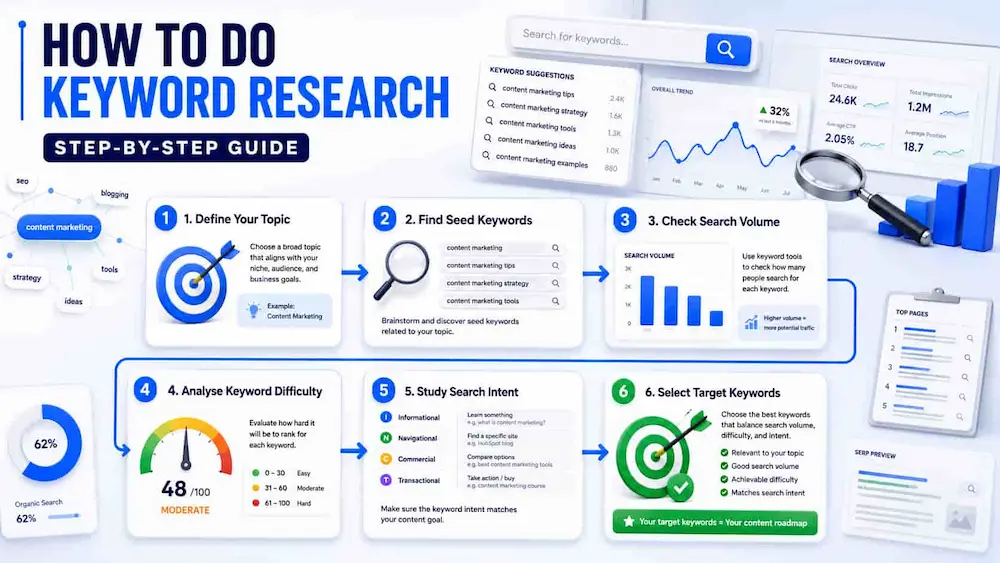
Learning how to do Keyword Research for Beginners step by step is crucial, as the success of an effective SEO strategy depends on the proper execution of a clear process. Rather than selecting random search terms, one can follow these easy steps to identify keywords suitable for your audience.
Step 1: Start with a Seed Topic
Consider the general topic that your target audience is searching for. A seed topic must be somehow related to your business, blog or niche.
For instance, if you have a website dedicated to SEO, possible seed topics might include:
- Basic SEO principles
- Content marketing
- Search engine optimization
- Web traffic
These rather vague topics will help you generate dozens and hundreds of search terms.
Step 2: Make Use of SEO Tools
Once you pick your topic, start using reliable SEO tools in order to gather keyword suggestions. Metrics that should be considered include:
- Search Volume
- Keyword Difficulty
- Search Intent
- Competition
- Trend Data
Forget about targeting high-volume keywords; consider keywords that are realistically ranking for your website.
Step 3: Competitor Analysis
Analyze the websites that rank on the first page of Google.
Consider these questions:
- What topics are discussed there?
- What headings are used?
- What are the questions they answer?
- What related terms can be found in the content?
Step 4: Group Related Keywords
Instead of creating unique pieces for each variation, put together all the search terms in one big topic.
For example, there could be one guide that would address such topics as:
- SEO keyword strategy
- Long-tail keywords
- Search intent
- Keyword difficulty
- Search volume
It will increase topical relevancy and make the content better for the reader.
Step 5: Create Helpful Content
Having done the keyword research, start working on the content that would help the reader solve the issue he is experiencing.
Use appropriate headings, data, examples and create structured piece of work. The helpful content attracts readers and increases the chance of getting links and being shared.
Common Keyword Research for Beginners Mistakes to Avoid

There are a number of simple things that beginners do which influence SEO negatively.
Be careful not to do the following:
- Choose keywords solely based on their high search volume.
- Ignore search intent.
- Opt for highly competitive keywords when you have a new website.
- Create thin and duplicate content.
- Insert the same keyword repeatedly into the text.
- Don’t update old content with new information.
In every case, user’s needs must come first before the needs of search engines.
EEAT in SEO Optimization
When applying Keyword Research for Beginners, Google prefers content created by trusted experts with high (EEAT).
- In order to increase EEAT, it is needed to:
- Share accurate and up-to-date information.
- Illuminate the topic through examples.
- Cite reliable sources where necessary.
- Create helpful and unique content.
- Keep your articles updated along with the development of SEO trends.
- When the readers trust your content, search engines will trust it as well.
Rank Math Optimization Tips
If you’re using Rank Math SEO, consider implementing the following best practices before you publish your article:
- The inclusion of the Focus Keyword in the SEO Title.
- Naturally incorporate the keyword in the first paragraph.
- Incorporate the keyword in at least one H2 tag.
- Write a good meta description.
- Create a keyword-optimized URL.
- Provide relevant image ALT text.
- Embed internal links to related articles.
- Embed links to credible external sources where necessary.
- Incorporate a Table of Contents in long articles.
- Incorporate FAQ schema to answer user queries.
Frequently Asked Questions (FAQs)
1. What is keyword research for Beginners?
Keyword research for Beginners involves finding the key terms used by users in their searches on search engines to look for information, products or services.
2. Why is keyword research for Beginners important in SEO?
Keyword research for beginners helps you learn more about your audience, target search terms, boost search ranking and drive qualified traffic organically.
3. Which are the best keyword research tools for Beginners?
Some of the widely used free keyword research tools are Google Keyword Planner, Google Trends, Google Search Console and Ubersuggest.
4. What is the difference between short tail and long tail keywords?
Short tail keywords are general and highly competitive, whereas long tail keywords are usually specific, less competitive and more likely to convert.
5. How often should I change my keyword strategy?
Your keyword strategy should be re-evaluated at least a few times every year.
Conclusion
Mastering Keyword Research for Beginners is essential for building a successful and sustainable SEO campaign. It will help you understand your audience, define the right intent of their search, use proper keywords and create high-quality content and thus promote your website and attract visitors. Instead of focusing on the number of searches for a particular keyword, pay attention to its relevance, intent and quality of content. Using primary, secondary and LSI keywords naturally and using EEAT principles and on-page SEO rules will enable you to create such content that would be useful both for users and for search engines.