
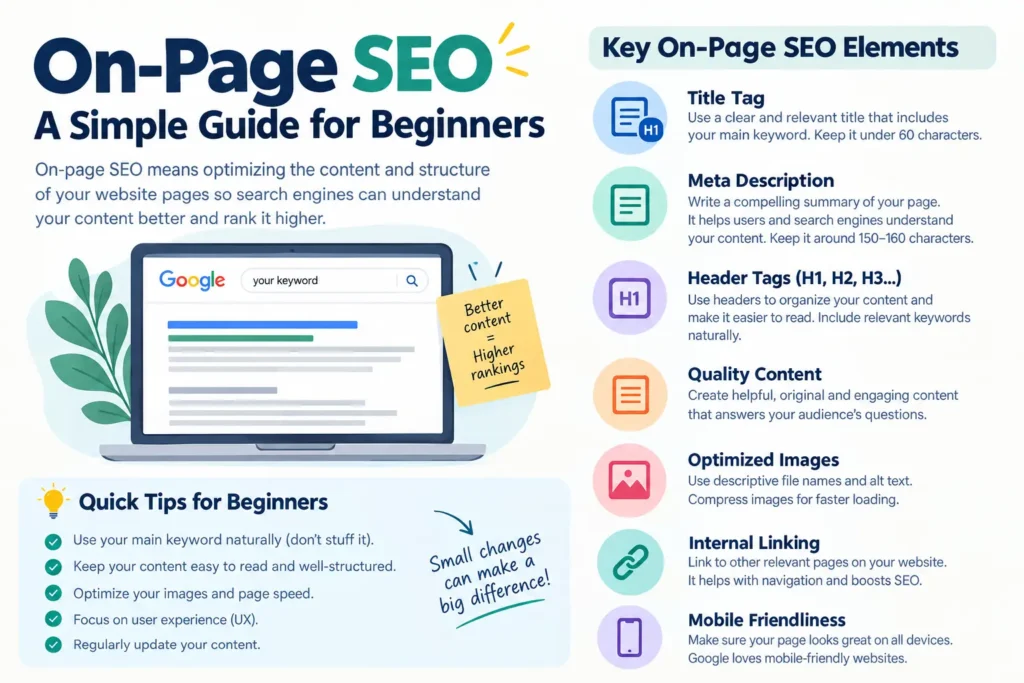
For a higher ranking and better traffic of your website on Google, On-Page SEO Guide for Beginners is the first and foremost thing you need to know. As Off-Page SEO deals with backlinks, On-Page SEO refers to the optimization of the website itself.
In this On-Page SEO guide for Beginners, you will come to know how to optimize your website with its right techniques.
What is On-Page SEO?
On-Page SEO (sometimes referred to as On-Site SEO) is the process of optimizing websites’ individual pages for better ranking and increased traffic through search engines. This process includes optimization of visible content as well as underlying HTML code of a website’s page.
Main Components of On-Page SEO Guide for Beginners That Should Be Optimized
1. Title Tags & Meta Descriptions
Title Tag: Keep it under 60 characters and put your keyword in there early. Make sure it’s catchy to boost Click-Through Rate (CTR).
Meta Description: Keep it at about 150-160 characters. It should be accurate and have a call-to-action (CTA
2. Headings & Content Structure (H1, H2, H3)
Do not use more than one H1 tag on a page (typically, the heading of your post).
Use headings in order to split up the content and make it readable for both users and spiders.
Secondary keywords should be integrated into your headings naturally.
3. URL Structure
Make sure that the URL is short and clear.
Ensure that the target keyword is included in the URL (e.g., [yourwebsite.com/on-page-seo-guide](https://yourwebsite.com/on-page-seo-guide)).
Do not use special characters or dates or anyMake sure that the URL is short and clear.
Ensure that the target keyword is included in the URL (e.g., [yourwebsite.com/on-page-seo-guide]
4. Keyword Optimization & Intent
Insert the focus keyword into the first 100 words of your writing.
Use natural keyword density (between 1% and 2%). No stuffing allowed.
Make sure that your content matches the search intent.
5. High-Quality Content & Engagement
Write unique and well-optimized content that helps solve the problem of the user.
Use bullet points, bold fonts, and short paragraphs to improve readability and increase time spent on the page.
6. Image Optimization
Give a meaningful name to your images (e.g., on-page-seo-checklist.png rather than IMG001.png).
Give all images an Alt Text to help search engines know more about the images.
Optimize images to decrease their load time.
7. Internal and External Links
Internal Links: Add 2–4 internal links pointing to related topics on your website (such as our ultimate [SEO for Beginners Guide]).
External Links: Link out to authoritative, trusted sources to support your claims and add value for readers.