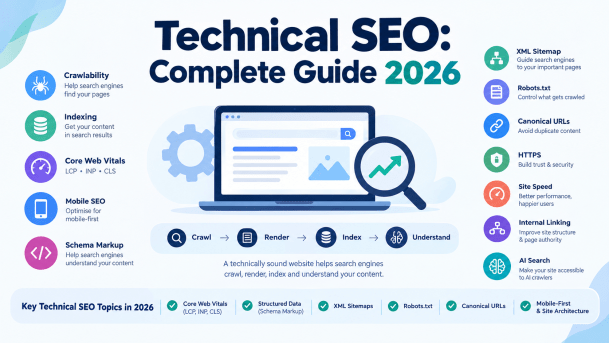
In today’s online marketing area, high-quality content and effective backlinks are just two aspects of the process. If your website fails to be crawled, rendered, and indexed by search engine crawlers efficiently, or the user experience is negatively impacted by poor speeds, then you will have difficulty ranking for the content you create. Technical SEO Guide serves as the engine behind your website.
What Is Technical SEO Guide?
Technical SEO Guide involves optimization techniques that allow search engines to crawl, render, and index your website. As opposed to optimization techniques that only impact the surface level of your website, technical SEO involves deeper optimization regarding the structure of your site, its code, server performance, and modern performance standards.
The 8 Core Web Vitals & Performance Metrics Explained
In order to provide a good user experience and meet the Page Experience signals by Google, technical SEO Guide includes the following eight metrics:
1. Core Web Vitals (Main Ranking Signals)
LCP (Largest Contentful Paint):
Loading performance. It is concerned with measuring the time needed for rendering the biggest visual part of the web page (hero image or headline).
Goal: \le 2.5 seconds
INP (Interaction to Next Paint):
Responsiveness measurement. It measures the time elapsed between a user interaction with a web page and its reaction (visual change).
(Formerly known as FID).
Goal: \le 200 milliseconds
CLS (Cumulative Layout Shift):
Visual stability. It measures unexpected changes of layout during the entire lifetime of the web page.
Goal: \le 0.1
2. Diagnostic & Speed Metrics
TTFB (Time to First Byte):
Refers to the time it takes for the server to respond. It refers to the time elapsed between the request by the browser for a particular page until the receipt of the first byte of data from the server.
Target: \le 0.8 seconds
FCP (First Contentful Paint):
Indicates the moment when the browser begins rendering any DOM content (text, images, SVG or Canvas).
Target: \le 1.8 seconds
TBT (Total Blocking Time):
Describes how interactive the page is during loading. This metric measures the amount of time that elapses between the FCP and TTI due to main-thread JavaScript tasks blocking user interaction.
Target: \le 200 milliseconds
Speed Index:
Refers to how quickly the page loads the visual contents.
Target: \le 3.4 seconds
TTI (Time to Interactive):
Measures the time taken for the page to become fully interactive and be able to respond to any user action.
Target: \le 3.8 seconds
Key Pillars of Technical SEO Execution
Website Structure and Crawlability
XML Sitemap:
Develop XML sitemaps and submit them via Google Search Console to ensure that the bots know which pages on the site are worth crawling.
robots.txt Directives:
Use robots.txt files to instruct the crawlers which directories need to be indexed but do not allow others such as admin folders and dynamic search results pages.
Crawl Depth:
Build the website in a manner that allows the most valuable landing pages to be accessible in at most three clicks from the homepage.
Mobile-First Indexing & Security
Responsive Design:
Consistent viewport, text zooming, and touch target sizes are crucial for mobile-friendly designs.
HTTPS:
Use an SSL/TLS encryption certificate for secure data transfer, a basic level of website security for search engines.
Indexation Control and Schema Markup
Canonical Tags:
Use canonical URLs for resolving issues of duplicated content due to URL parameters or syndicated landing pages.
Structured data:
Use the JSON-LD markup for contextual markup (articles, local business, products) and also for improving the SERP through rich snippets.
How to Maintain Technical SEO in Good Shape
Technical SEO Guide requires continuous maintenance. With time, there is a risk that it might stop working effectively because of adding more plugins and scripts, images, etc. Conducting audits with the help of Google Search Console, PageSpeed Insights, Screaming Frog will make sure that any link breaks or other issues are fixed on time.